Book
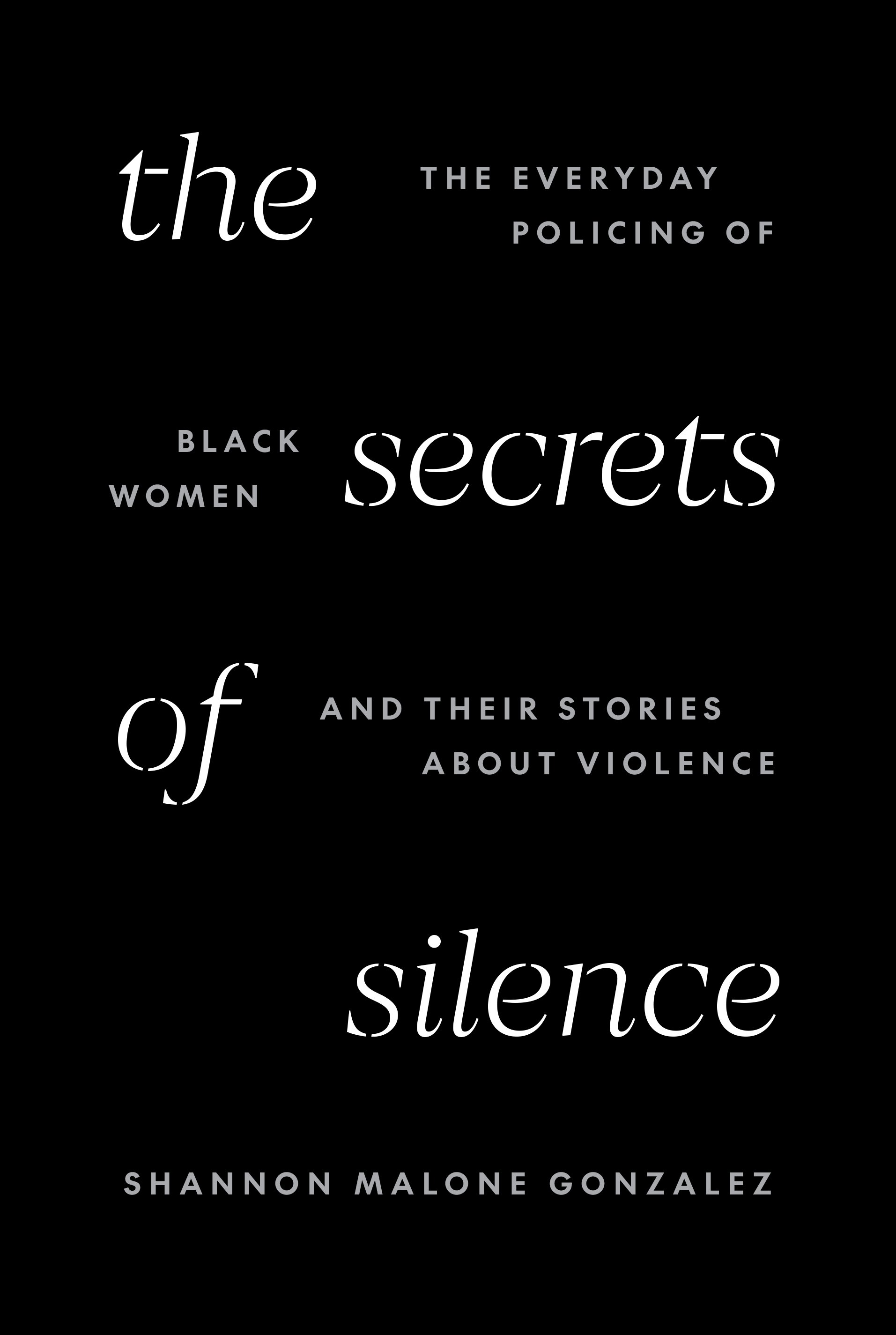
The Secrets of Silence: The Everyday Policing of Black Women and Their Stories about Violence (Princeton University Press)
Why black women’s stories of encounters with the police are missing from official and unofficial accounts of police violence
In The Secrets of Silence, Shannon Malone Gonzalez investigates how the policing of black women is tied to the policing of their stories. Over a period of four years, Malone Gonzalez conducted intimate life-history interviews with black women about their encounters, listening to those who had never shared their stories before, had never even been asked to, or had tried repeatedly to speak to those around them to no avail. They all described the unspoken or whispered connections in the ways officers and communities socially control black women to put them “in their place.” Centering black women’s searches for recognition of their violent encounters with police and other people in their lives, Malone Gonzalez examines the pervasive and often invisible forms of everyday policing that render black women’s stories missing from official data, headlines, and community conversations.
Articulating what she calls “the space between” recognition of black women’s stories and their encounters, Malone Gonzalez shows that policing is as much about silence as it is about violence. Black women’s silenced stories, then, provide a way to name and critique the institutional and intimate forms of policing that break and bend black social relations into a complex web of social control. Drawing on abolition feminism and black knowledge traditions, she envisions storytelling—and listening—as a way to reimagine, remember, and reconnect in solidarity and worldbuilding.
“The Secrets of Silence is a powerfully, beautifully, and carefully written exploration of black women’s experiences with police violence. Malone Gonzalez dives into the unrelenting, the traumatic, and the enduring grief with an ethic of care and an attention to rigor that is simply masterful. It is a gutting and necessary intervention into how we understand policing and state violence.”—Treva Lindsey, author of America, Goddam: Violence, Black Women, and the Struggle for Justice
“Meticulously researched and deeply thoughtful, The Secrets of Silence presents a timely, in-depth, and story-driven look at the ‘deeper processes at work within our social world’ by chronicling black women’s experiences with police violence. Through her analysis of the impact of policing on black women and the impact it has on these women’s lives, Malone Gonzalez reveals that black women’s stories have not only been ignored but also invisibilized—erased by our nation’s refusal to recognize and take heed of black women’s pain. This study is urgent and necessary, analytically savvy, and deeply caring. We must listen to black women. Our society depends on it.”—Christen A. Smith, author of Afro-Paradise: Blackness, Violence, and Performance in Brazil
“In deep dialogue with black feminist scholars and activists, The Secrets of Silence fills critical gaps in sociology and public discourse with the lived truths of black women and girls. With lyrical clarity and rigorous research, Shannon Malone Gonzalez brings their voices to the center, revealing how everyday police violence is entangled with broader systems of social control. This powerful book is not only a compelling corrective but also an inspiring invitation to reimagine justice.”—Dorothy Roberts, author of Killing the Black Body
“This is far more than a book about policing. It’s a book about what we refuse to see, and who we refuse to hear. With profound care and ethnographic power, Malone Gonzalez brings us into the silences black women carry—and how those silences are structured, sanctioned, and survived.”—Forrest Stuart, author of Ballad of the Bullet: Gangs, Drill Music, and the Power of Online Infamy
“The Secrets of Silence is quite original, paying attention to policing in a holistic, intersectional, and feminist way. Black women’s and girls’ narratives about police encounters allow us to not only see the social control of policing, but also that silence is socially constructed in black women’s policing experiences. Silence is not an absence, but rather a type of narrative feature that tells how policing punishes entire communities, not just the young men in them.”—Saida Grundy, author of Respectable: Politics and Paradox in Making the Morehouse Man
“The Secrets of Silence is compelling. With painstaking care for victims and survivors of police brutality and through astonishing revelations, Malone Gonzalez brilliantly explains why women and girls’ heartbreaking narratives about police and state violence are absent from news headlines, official reports, and public conversations.”—LaShawn Harris, author of Sex Workers, Psychics, and Numbers Runners: Black Women in New York City's Underground Econom
“Secrets of Silence is a beautiful, bold, and disruptive intervention—an honest, tender, and imaginative model for black feminist sociological theorizing and methodology par excellence. Shannon Malone Gonzalez deploys ethnographic methods to unmute the everyday policing and violence that sustains black women’s intersectional vulnerabilities to harm by officers and others in public, private, and the liminal spaces between. With clarity and conviction, this text offers a necessary callout and a collective gathering, reaffirming our commitment to liberation and the transformative power of black feminist thought.”—Whitney Pirtle, coeditor of Black Feminist Sociology: Perspectives and Praxis
Peer-Reviewed Articles
Shannon Malone Gonzalez. 2019. “Making It Home: An Intersectional Analysis of the Police Talk”
Black mothers often are responsible for teaching their children how to respond to police violence. Through 30 in-depth interviews with black mothers from diverse social class backgrounds, I investigate how they address the gendered racial vulnerability of their children in the “police talk,” a socialization practice designed to prepare children for police encounters. I identify mothers’ primary discourse as “the making it home” framework, which encapsulates in parent–child socialization their use of double consciousness around the police. This framework marginalizes girls’ experiences in three ways: it conceptualizes boys as the primary targets of police, while constructing girls as collateral targets of police violence; it emphasizes masculine forms of violence; and it is directed almost exclusively at boys. An intersectional analysis is applied to redress the limitations of the police talk and to highlight the need for structural reforms to recognize and combat police violence against black women and girls.Shannon Malone Gonzalez. 2022. “Black Girls and the Talk: Policing, Parenting, and the Politics of Protection”
Black girls are marginalized from mainstream discourses and familial discussions on policing, and little is known about how families conceptualize strategies for mitigating their risk of police sexual assault and harassment. Through 30 in-depth interviews with black mothers, this article explores how social class shapes protective care strategies for reducing girls’ risk of police contact and sexual violence. While the primary police talk emphasizes black boys’ vulnerability to lethal and physical violence, I identify two additional socialization practices, or “talks” for black girls: The respectability talk is a middle-class socialization strategy that avoids direct associations between black girls and police; this talk works to minimize risk through teaching black girls how to be “ladies” by embodying racialized gendered norms that constrain their behavior and autonomy. The predatory talk is a predominantly working-class socialization strategy which aims to equip black girls with an awareness of police sexual violence and the tools for avoiding sexual assault and harassment from officers when alone or at night. The article illustrates how protective care strategies for black girls are intertwined with social class and have divergent consequences for understanding agency and responsibility for police sexual violence.Shannon Malone Gonzalez, Samantha J. Simon,and Katie Kaufman Rogers. 2022. “The Diversity Officer: Police Officers’ and Black Women Civilians’ Epistemologies on Race and Racism in Policing”

Diversifying police forces has been suggested to improve “police-minority relations” amidst national uprisings against police violence. Yet, little research investigates how police and black civilians—two groups invoked in discourse on “police-minority relations”—understand the function of diversity interventions. We draw on 100 in-depth interviews with 60 black women civilians and 40 police from various racial and ethnic backgrounds to explore how they understand the function of racial diversity in policing. Findings highlight discrepancies in how these two groups frame the utility of racial diversity in policing, revealing conflicting epistemologies of race and racism. Police draw on an epistemology of racial ignorance (Mills 1997, 2007, 2015) to selectively accommodate race-conscious critique while denying the history and power dynamics between the institution and minority communities. Conversely, black women civilians, grounded in a standpoint epistemology (Collins, 1986, 2009), emphasize the historical roots of policing, along with collective memories, and lived experiences to understand the relationship between the institution and minority communities. Through a comparative analysis of these frames, we theorize dominant/state-sponsored discourse on diversity and police-minority relations as form of racecraft (Fields & Fields 2012, 2014) that serves to legitimize negligible institutional change to policing in an era of renewed scrutiny of police racism.Shannon Malone Gonzalez and Faith M. Deckard. 2024. “‘We Got Witnesses’: Black Women’s Counter Surveillance for Navigating Police Violence and Legal Estrangement”
Police violence shapes the lives of racial and ethnic minorities, and while much has been written about strategic responses to police, missing is an examination of how black women navigate interactions with officers. Based on 32 interviews with black women, we find that they use witnessing, or the mobilization of others as observers to police encounters. Research demonstrates the rising role of videos and smartphones in documenting encounters with officers. We find that black women adapt witnessing techniques based on their surroundings, available resources, and network contacts. Three forms of witnessing are observed: physical witnessing, mobilizing others in close proximity to interactions with officers; virtual witnessing, using cellphone or social media technology to contact others or record interactions with officers; and institutional witnessing, leveraging police or other institutional contacts as interveners to interactions with officers. Black women mobilize witnessing to deescalate violence, gather evidence, and promote accountability. Attuned to both the interactional and structural dynamics of police encounters, black women conceptualize witnessing as a way to survive police encounters and navigate their legal estrangement within the carceral system. We theorize black women’s witnessing as a form of resistance as they work to reconfigure short- and long-term power relations between themselves, their communities, and police.Shannon Malone Gonzalez, Shantel Gabrieal Buggs, and J’Mauri Jackson. 2025. “‘Mourning for Strangers’: Black Women, Sequelae, and the Digital Afterlife of Police Violence”
Based on 32 in-depth interviews with black women, this paper analyzes the racialized and gendered impact of vicarious exposure to police encounters on social media. We draw from Smith’s (2016) sequelae to describe the lingering effects of anti-black state violence, particularly grief and mourning. For Black women, the manifestation of sequelae from online exposure includes: a) amplification of police brutality, b) identification with victims, c) expressions of grief, and d) prolonged mourning. We argue research should contend with the digital landscape when examining psychological effects of police violence to understand anti-black police violence’s impact on gendered racial mental health disparities.Faith M. Deckard, Shannon Malone Gonzalez, Yasmiyn Irizarry, and Jaime Feng-Yuan Hsu. 2026. “Perpetual Encounters: Reconceptualizing Police Contact and its Relationship to Black Women’s Mental Health”
Research and media discussion of police contact routinely conceptualize it as time-constrained interactions between officers and civilians. However, extant literature documents preparation for encounters and post-encounter advocacy, which each challenge restricted understandings of contact and, importantly, its relationship to mental health. We introduce “perpetual encounters” to both theoretically and empirically move closer to the temporally unbounded and enduring way that police contact is experienced in black women’s everyday lives. Utilizing a novel, nationally representative dataset on their policing experiences, we explore how mental health is independently and conjointly associated with three dimensions of police contact: preparation, police stops, and advocacy against police violence. Beyond exemplifying how pervasive the police are in the day-to-day lives of marginalized communities, extending the scope of contact recognizes preparation as a significant threat to mental health and advocacy as a health-promoting activity. This study supports moving beyond discrete notions and measurement of police contact to process-oriented understandings and relational modeling.Amber Joy Powell, Faith M. Deckard, Shannon Malone Gonzalez, and Brittany Pearl Battle. 2026. “Abolition Feminist Storytelling as Methodology: Lessons Within the Stories We (Re)Tell about Violence”
This paper engages abolition feminist storytelling as a methodology for feminist criminologists to identify, reflect on, grapple with, and ultimately confront carceral logics in the stories we (re)tell about violence and punishment. Drawing on over a decade’s worth of research, advocacy, and community organizing, we identify three carceral tensions that emerged within our own storytelling: the victim-offender binary, researcher complicity, and a survivor standpoint. Building on prior black feminist scholarship, we then illustrate how an abolition feminist approach to storytelling allows us to confront these tensions through relationality, an ethic of love, accountability, vulnerability, and commitment to justice.